





01 — Transformation Cost Control
Stop waste before it reaches the ledger.
Most transformation programmes bleed quietly — scope drift, duplicated tooling, vendors billing for effort rather than outcomes. Validra finds it early and attaches the evidence to act.
What Validra acts on
Validra reads the commercial signals enterprises already produce — and acts on them.
Categories of signal, not method. Each one resolves into a defensible recommendation with the evidence to support it.
Billing vs contract drift
Revenue earned but not billed correctly.
Unbilled entitlements
Services delivered but not invoiced.
Transformation spend without outcome
Programmes spending without delivering savings.
Latent revenue in served customers
New offerings credible with existing customers.
Vendor effort decoupled from delivery
Suppliers billing for effort, not outcomes.
Pricing exposure under regulatory change
Commercial terms at risk from regulatory shifts.
The standard of proof
Every Validra recommendation is defensible, auditable, and reversible.
The three properties enterprise buyers in regulated markets are required to demonstrate — built into the platform, not retrofitted around it.
Defensible
Every recommendation cites the source records it stands on. No black-box outputs reach the boardroom.
Auditable
Every action leaves a trail a regulator, internal audit, or external counsel could follow without translation.
Reversible
No commercial action ships without a stop-condition. If reality moves, the recommendation withdraws itself.
Where Validra fits
Above the dashboard. Below the decision.
Validra reads from the systems of record an enterprise already operates and produces the commercial actions those records justify.
Systems of record
Validra
Reads ·Reconciles ·Recommends
Commercial action
Validra does not replace dashboards or BI. It sits above them and produces what they cannot: a defensible commercial action.
The five Validra engines
Five commercial outcomes. One standard of proof.
Each engine acts on a different part of the enterprise. Together, they cover the full commercial life of a regulated organisation.
Engine 01
Transformation Cost Control
Stop waste before it reaches the ledger.
In plain English
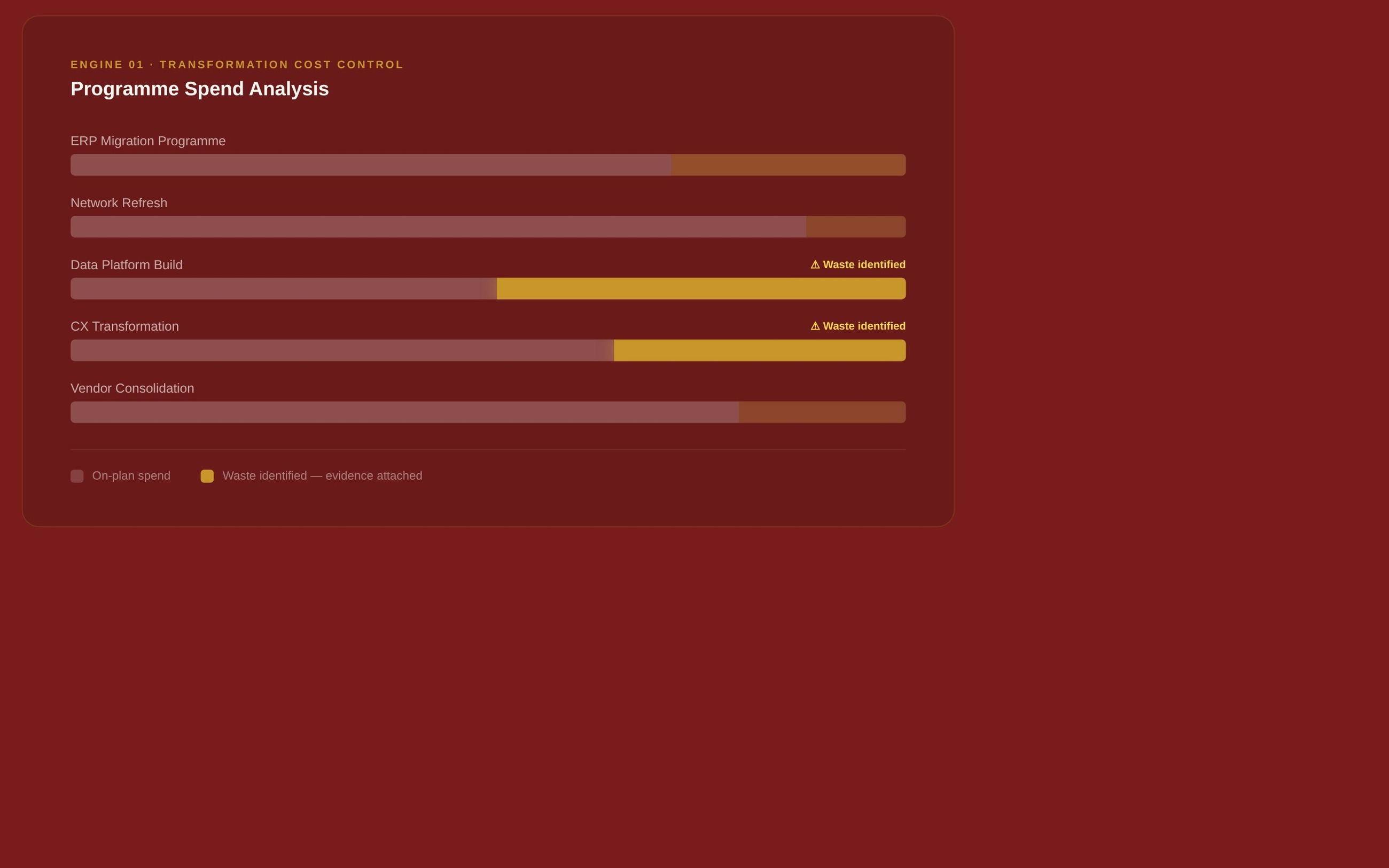
Spending without commercial outcome — surfaced and stopped before it embeds in the run-rate.
Anatomy of a finding
What a Validra finding looks like.
One anonymised example. Every finding follows this structure.
Signal
A contracted service entitlement shows active in delivery records for 14 months. No matching billing line exists in the same period.
Evidence
The finding cites the contract clause, the delivery records, and the billing extract. Every record is source-linked. Nothing is asserted without a citation.
Recommendation
Recover the unbilled amount under the existing contract terms — drafted in language commercial and legal teams can act on directly.
Stop-condition
If the underlying records change — a credit note, a contract variation, a dispute — the recommendation withdraws itself and says why.
Defensible, auditable, reversible — demonstrated, not claimed.
How an engagement runs
From first conversation to commercial outcome.
01
Scope
A defined commercial question, a defined set of records, a defined period. No open-ended access.
02
Read
Validra reads from your systems of record under read-only, role-segregated access. Nothing is changed.
03
Evidence
You receive findings with the full evidence trail. Your teams can challenge every line before anything is acted on.
04
Outcome
Commercial terms are tied to validated outcomes. If the findings don't stand up, neither does the fee.
Pilot engagements are structured so the evidence is tested before the commitment is made.
Early evidence
Being tested where it matters.
Validra is currently in structured pilot engagements with enterprise organisations in telecommunications and financial services. Early findings are shared under confidentiality with qualified prospects and partners. If you are evaluating Validra for a specific commercial challenge, contact us to request a pilot summary relevant to your sector.
Principles
How Validra is built — and why it reads differently to the rest of the category.
01
Evidence before action
Nothing is recommended without the records that justify it. The proof is part of the output, not an afterthought.
02
Outcomes, not dashboards
Validra is measured by money moved — recovered, stopped, created — not by reports produced.
03
Reversible by default
Every recommendation carries a stop-condition. If the underlying signal changes, the action withdraws itself.
04
Regulated by design
Built for organisations where actions have to survive audit, regulator scrutiny, and internal challenge — not just internal review.
A different standard
Most enterprise platforms report. Validra acts.
Validra is built for enterprises that need defensible commercial action — not another dashboard.
01
Dashboard produced
02
Manual decision
03
No evidence trail
04
Commercial action deferred
Built for regulated enterprises
The non-negotiables of operating in a regulated market — handled.
UK data residency
Records processed and retained inside UK boundaries.
Role-segregated access
Read, recommend, and act are separable roles by default.
Evidence retention
Every recommendation's supporting records held under your retention policy.
Change-controlled deployments
Versioned releases, rollback paths, no silent updates.
Questions buyers ask
What serious enterprise buyers want answered before the second meeting.
Who is behind Validra
A founding team built for the environments Validra operates in.
Validra is built by a founding team with three decades of enterprise technology delivery across telecommunications and financial services — the regulated environments the platform is designed for.
The platform's methods are the subject of multiple UK patent applications.